




HiCNC Robotic Shoe Manufacturing Solution: Solving the Footwear Industry’s Automation Challenge
Key Takeaways
- HiCNC’s intelligent flexible shoe manufacturing line combines machine vision, robotics, big data, and AI to enable human-robot collaboration and mixed-model production across multiple shoe sizes and styles on a single line.
- The system uses HiCNC HSR-JR605 and HSR-BR610 robots for 3D upper scanning, automated glue dispensing, buffing/roughing, and automatic loading/unloading during sole pressing.
- Proprietary technologies include path-planning algorithms for glue application, dual-station and dual-gun spraying, real-time angle-compensation for uneven surfaces, and anti-clogging glue gun design.
- Real-world deployment: a cold-cement shoe production line achieves a cycle time of 260 pairs/hour (2,600 pairs per 10-hour shift), cutting the workforce from 65 to 26 operators — a 60% reduction in labor.
- The solution is already running in footwear manufacturing hubs including Quanzhou, Putian, Wenzhou, and Nanchang, China.
Industry Background: Why Footwear Manufacturers Need Automation Now
China has long been the world’s largest footwear manufacturing hub. But rising trade barriers, increasing raw material costs, and labor shortages are pushing shoe production toward Southeast Asia, putting Chinese manufacturers under mounting competitive pressure.
Footwear manufacturing is also a highly labor-intensive industry. Many traditional factories still rely on outdated equipment, difficult working conditions, slow production cycles, and a shrinking, increasingly expensive workforce. The case for intelligent upgrades in shoe manufacturing has never been stronger.
HiCNC’s intelligent flexible shoe manufacturing line addresses this directly. By combining machine vision, industrial robots, big data, and AI, the system enables human-robot collaboration and mixed-model production across different shoe sizes and styles — solving the core manufacturing pain point of fragmented, style-diverse orders that don’t fit rigid, single-line production.
The line is built around two HiCNC robot models:
HSR-JR605 — handles 3D vision scanning of shoe uppers, glue application, and surface marking/buffing.
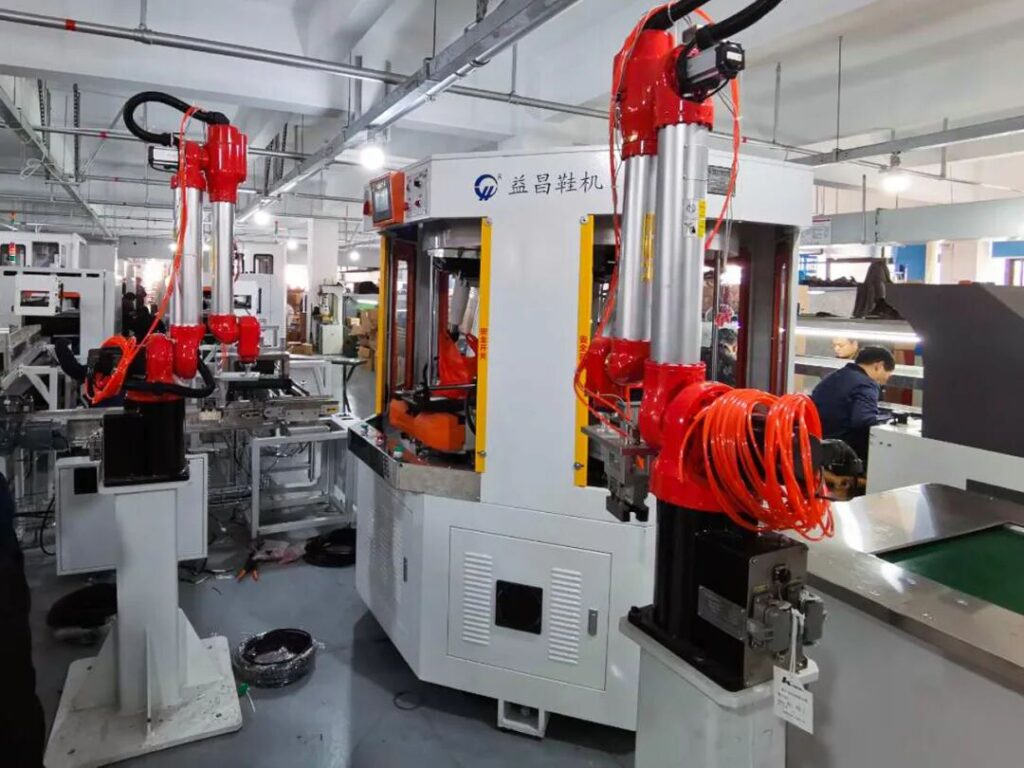
HSR-BR610 — manages automated loading and unloading during sole pressing.
Key Technologies Behind the Robotic Shoe Manufacturing Solution
- Vision-Guided Path Planning for Glue Application
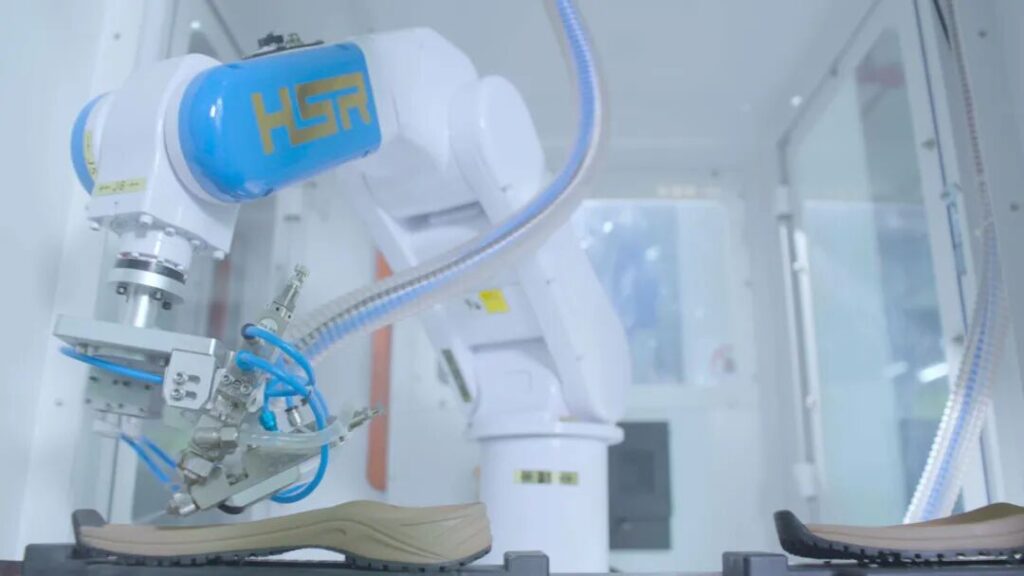
A proprietary 3D smart camera system scans each shoe upper on the line and generates the robot’s glue-dispensing path in real time. This vision-guided path planning delivers high-precision upper recognition and reliable trajectory extraction, even as shoe shapes and sizes vary from unit to unit.
- Automated Upper-Forming Process
The upper-forming stage combines several engineering solutions to keep pace with high-mix production:
Dual-station design — increases robot utilization for continuous, high-intensity spraying without downtime.
Dual-gun spraying — enables efficient, simultaneous or time-sliced glue application across different shoe styles.
Intelligent pressure control — adjusts glue pressure, flow rate, and spray width based on parameterized process recipes.
Real-time angle-compensation algorithm — corrects for uneven glue application caused by subtle variations between shoe uppers.
Anti-clogging glue gun design — combines glue tank design, piping, cleaning systems, and glue formulation to prevent nozzle blockages.
- Dynamic Follow-Along Sole Gluing
Built on the latest HiCNC Robot System III, the HSR-JR605 runs a custom glue-control system developed to customer specifications for real-time sole gluing. Its follow-along spraying system applies glue to soles while they continue moving along the conveyor — no stop-and-go required. An integrated 3D vision system scans and processes each sole in real time, while a graphical interface lets operators fine-tune spray parameters for local feature adjustments.
Features of HiCNC’s Intelligent Shoe Manufacturing Solution
Flexible Mixed-Size Production
High-efficiency 3D vision recognition dynamically identifies shoe size and subtle dimensional differences, using a process big-data platform for precise, automated size recognition.
Intelligent Forming Process
Industrial vision, robotics, RFID, big data, and cloud computing work together to capture, extract, process, and feed back shoe information, glue parameters, and marking/buffing parameters in real time — enabling refined, data-driven production management.
Human-Robot Mixed-Line Production
Operators and robots work side by side, safeguarding quality at critical steps while improving line utilization and overall efficiency.
Modular Line Design
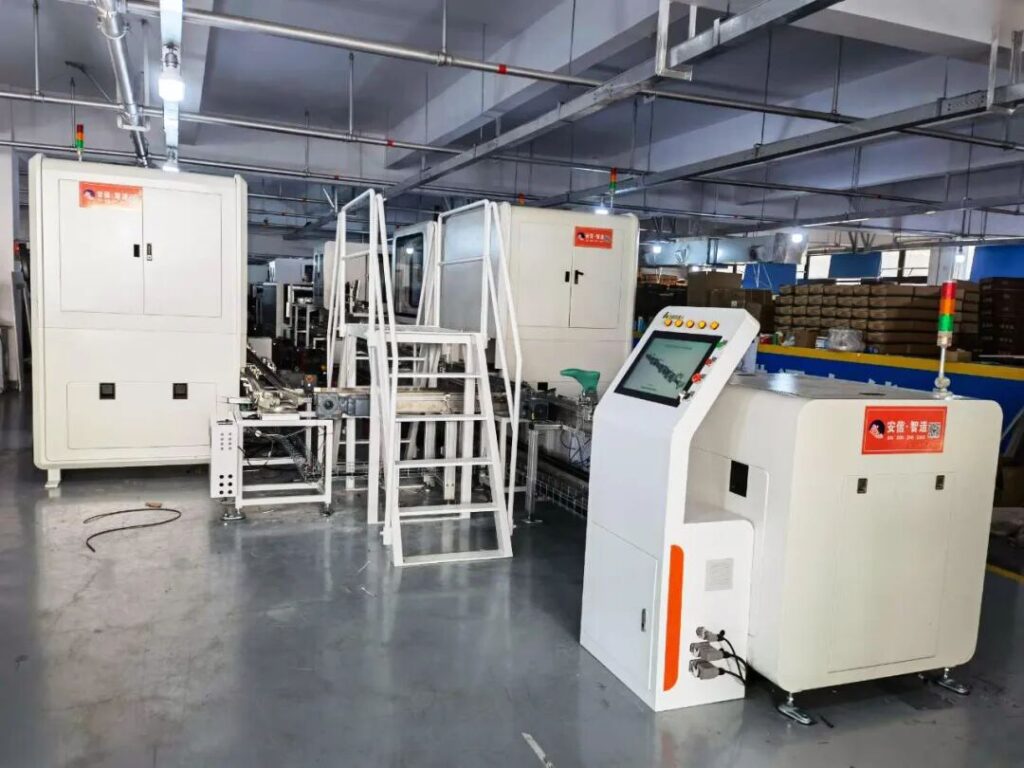
The production line supports both dual-line and loop-line configurations for different plant layouts. A lightweight, modular design fully isolates electrical, pneumatic, and adhesive systems — simplifying scale-up and line assembly.
Digital Production Management Platform
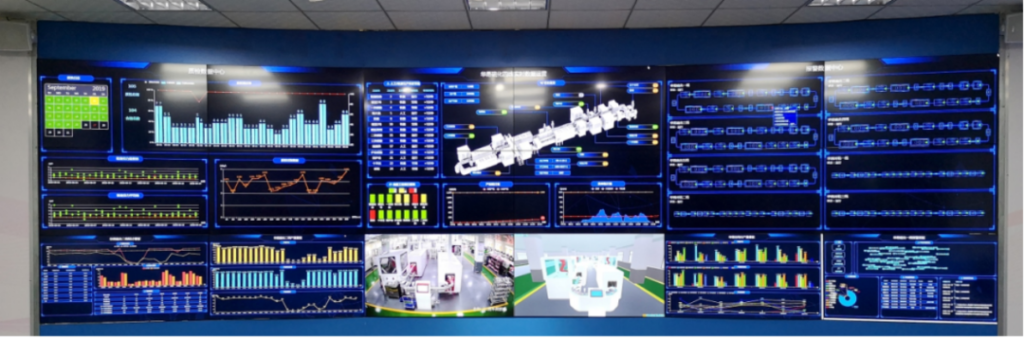
A dedicated manufacturing execution system, built on big data and cloud infrastructure, collects and processes order information, process parameters, equipment data, quality metrics, and fault alerts in real time — feeding back into production planning. 5G-enabled remote diagnostics let engineers pinpoint issues and manage troubleshooting off-site.
Energy-Efficient and Environmentally Friendly
Based on real-time quality-tracking feedback, the system intelligently controls oven temperature and conveyor speed to cut heat waste. A negative-pressure design across the line effectively extracts glue fumes, keeping the workshop clean and compliant.
Results: Real-World Performance Gains
HiCNC’s cold-cement shoe smart forming line, vulcanized shoe smart forming line, and upper-scanning/buffing line are already deployed across major footwear manufacturing regions, including Quanzhou, Putian, Wenzhou, and Nanchang.
On the cold-cement smart manufacturing line specifically:
Cycle time: 260 pairs per hour
Daily output: 2,600 pairs (based on a 10-hour shift)
Workforce reduction: from 65 operators down to 26 — a 60% cut in labor costs
Frequently Asked Questions
What is a robotic shoe manufacturing solution?
A robotic shoe manufacturing solution uses industrial robots, 3D machine vision, and AI-driven process control to automate steps like upper scanning, glue dispensing, buffing, and sole pressing — allowing factories to produce multiple shoe sizes and styles on the same line.
How does HiCNC’s system handle different shoe sizes on one line?
The system uses 3D vision recognition to dynamically detect each shoe’s size and shape, then adjusts the robot’s glue-dispensing path and spray parameters in real time — enabling mixed-size, mixed-style production without manual changeovers.
How much labor can automated shoe production save?
In HiCNC’s deployed cold-cement production line, workforce needs dropped from 65 to 26 operators — a 60% reduction — while maintaining a throughput of 2,600 pairs per day.
Which HiCNC robots are used in shoe manufacturing?
The solution is built around the HSR-JR605, used for 3D scanning, glue dispensing, and marking/buffing, and the HSR-BR610, used for automated loading and unloading during sole pressing.
Where is this solution currently in use?
The system is already operating in footwear manufacturing centers including Quanzhou, Putian, Wenzhou, and Nanchang, across cold-cement, vulcanized, and upper-scanning production lines.

