




Entering the World of Five-Axis Control | Secret 7: Servo Feedforward for Precise, Efficient Motion
In high-end CNC machining, the dynamic following accuracy of each feed axis directly determines contour accuracy and surface quality. This article explains how servo feedforward control on HCNC Group’s HSV series drives reduces following error and helps 5-axis machines deliver tighter contours and smoother surfaces.
Key Takeaways
- Conventional PID control generates drive commands from position error, so following error grows at high speed and high acceleration, causing corner overcut and roundness distortion.
- HCNC Group’s HSV series servo drives integrate a dynamic feedforward package with three modules: velocity feedforward, acceleration feedforward and friction feedforward.
- Feedforward compensates the required torque or current in the command domain, before the error appears, bringing servo tracking close to “zero lag”.
- Inertia identification runs in one click, and guided parameter tuning plus graphical roundness verification make commissioning straightforward.
- On a customer’s machine, drive-side feedforward brought A-axis reversal following error down to within 1.7 millidegrees and virtually eliminated streak marks on an impeller flow channel.
Why PID Alone Limits Following Accuracy in High-End CNC Machining
Traditional PID control relies on deviation to generate its drive command. In other words, the controller can only react after an error has already occurred. Under high-speed, high-acceleration conditions this delay leaves a large following error, which leads to problems such as corner overcut and roundness distortion.
Feedforward attacks the problem from the other side. Instead of waiting for the error, it compensates the required torque or current in the command domain ahead of time. This sharply reduces dynamic following error and lets the servo track its command with almost no lag, improving both machining accuracy and surface finish.
HSV Series Dynamic Feedforward: Function Overview
HCNC Group has integrated a dynamic feedforward package (Feedforward V1.0) into the drive side of the HSV series. It supports three feedforward functions that can be combined, so their effects stack while the commissioning process stays clear.
Version note: Dynamic feedforward is a standard feature of HCNC Group HSV series servo drives. Software version V2847 and above (including V2848) supports all of the functions described in this article.
| Feedforward type | What it compensates | Key parameters |
| Velocity feedforward | Following error during constant-speed motion | PA1 |
| Acceleration feedforward | Dynamic error during acceleration and deceleration | PB63, PA35, PB12/PB13 |
| Friction feedforward | Static and dynamic friction spikes at motion reversal | PB56, PB57, PB59, PB60 |
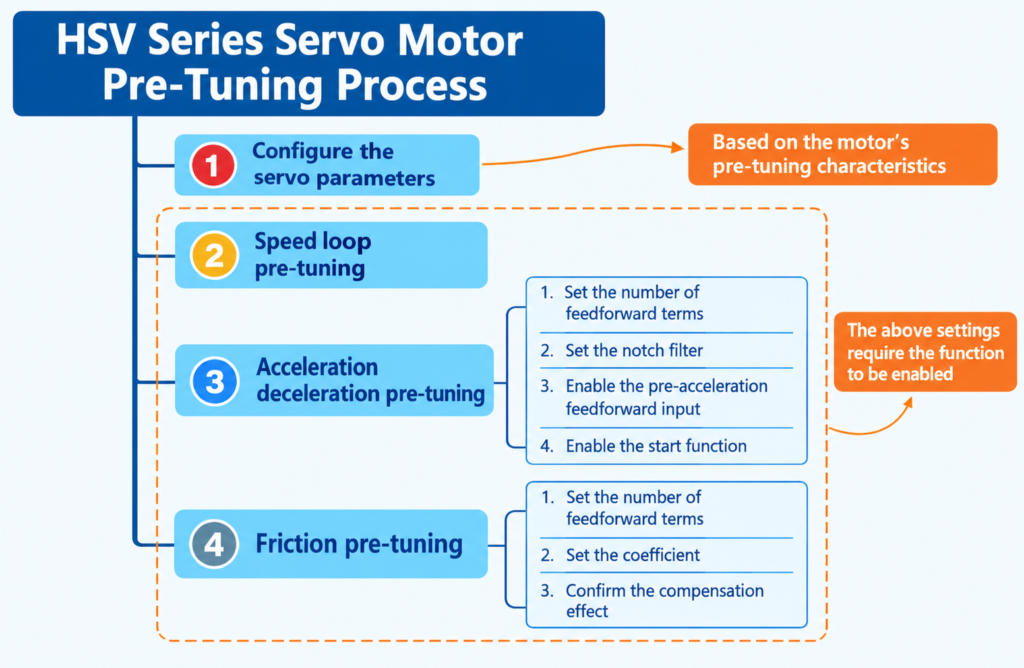
Recommended commissioning workflow
Servo parameter tuning → enable velocity feedforward → inertia identification → enable acceleration and friction feedforward as needed → verify with roundness test and waveform.
Velocity Feedforward: Near-Zero Following Error at Constant Speed
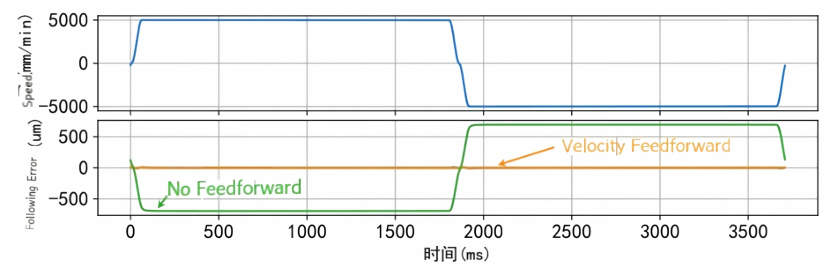
Velocity feedforward is the most basic form of feedforward. Once enabled, the system generates a feedforward torque directly from the commanded velocity, which greatly reduces following error during constant-velocity motion.
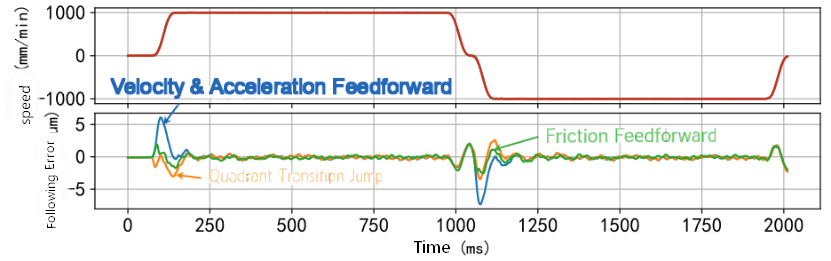
As the waveform below shows, setting velocity feedforward to PA1 = 100 brings the following error in the constant-speed segments down to almost zero.
Acceleration Feedforward: Removing Lag During Acceleration and Deceleration
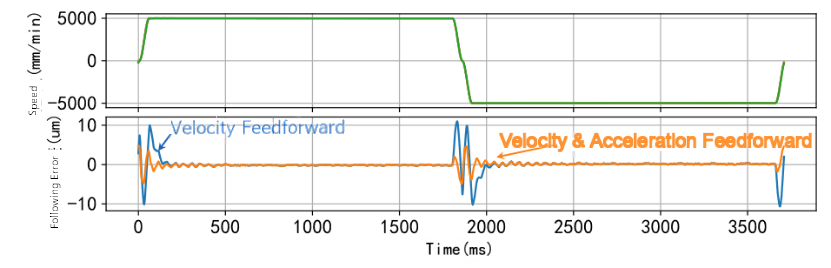
Acceleration feedforward needs an accurate load inertia ratio (PB12/PB13) and a suitably set filter coefficient (PA35). Inertia identification can be completed in one click from the Diagnosis → Servo Adjustment screen of the CNC system, and it supports both rotary motors and linear motors.
Key steps
- Run automatic inertia identification to generate PB12/PB13.
- Adjust PA35 so the acceleration feedforward signal is smooth (recommended range: PA35 = 200–500).
- Set PB63 = 100 to activate acceleration feedforward.
With acceleration feedforward added on top of velocity feedforward, the peak following error during acceleration and deceleration drops by more than 50%.
Friction Feedforward: Eliminating Reversal Spikes and Improving Roundness
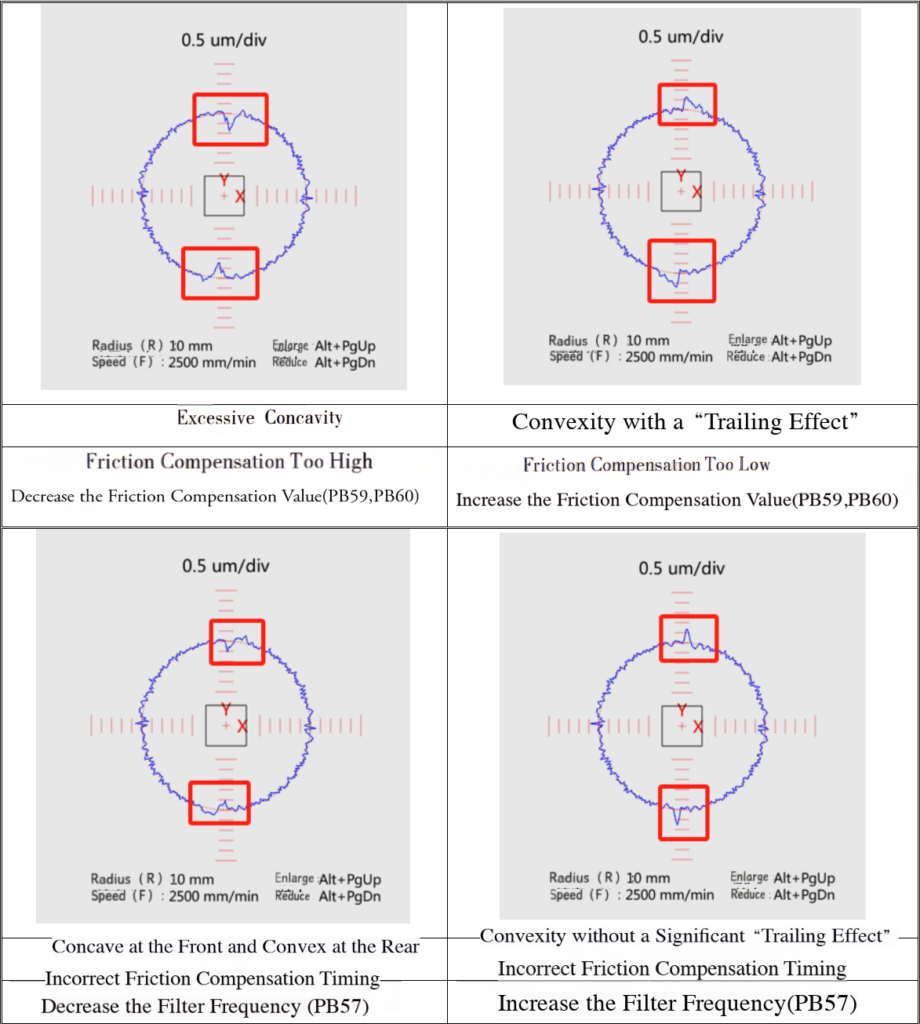
Transmission components such as ball screws and guideways have nonlinear friction. When an axis reverses direction, this friction makes the contour bulge outward or dip inward, a defect often seen as a reversal spike (quadrant glitch) in roundness tests. Friction feedforward compensates it precisely by identifying forward and reverse friction compensation values (PB59/PB60) and setting a filter frequency (PB57).
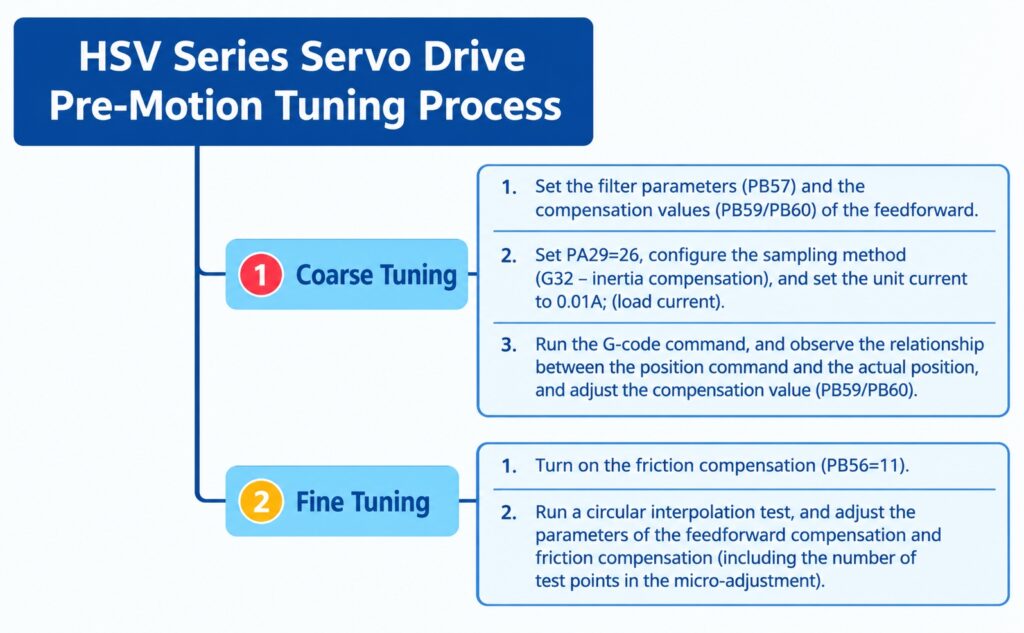
Tuning follows a simple two-stage process. First, determine the friction compensation values (PB59/PB60) and switch friction feedforward on. Then open the roundness tuning screen and fine-tune the compensation parameters according to the actual reversal-spike results.
With friction feedforward enabled on top of velocity and acceleration feedforward, following error in the reversal segments falls further, and the roundness test shows a clear improvement in reversal-spike compensation compared with friction feedforward switched off.
Real-World Result: Impeller Flow Channel Machining
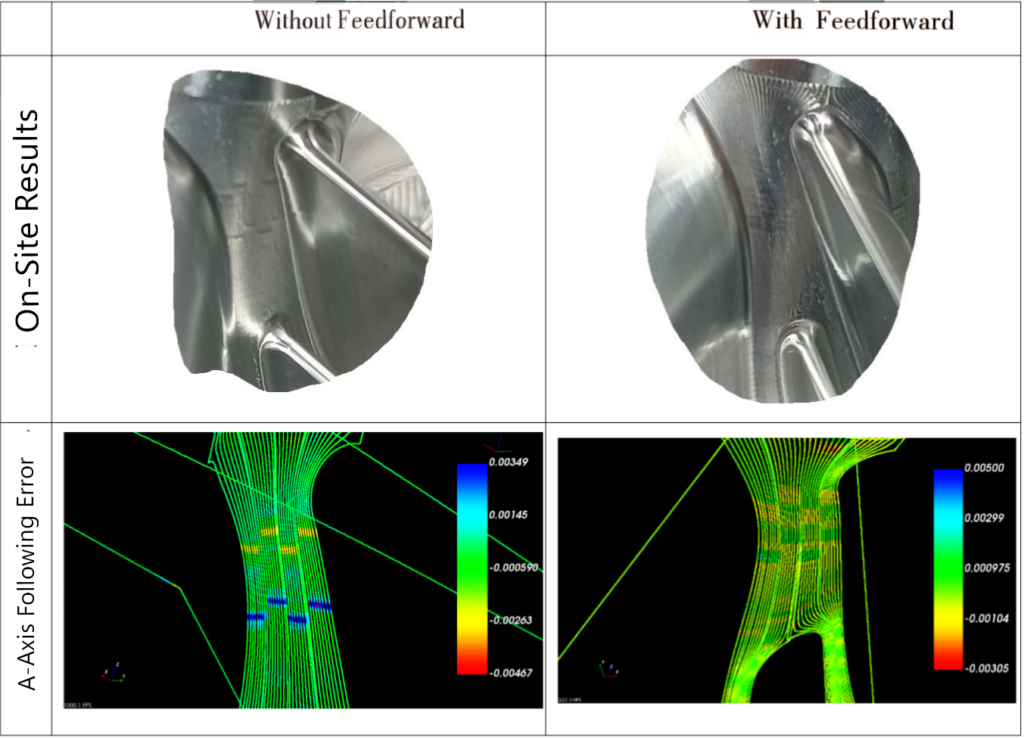
HCNC Group’s drive-side dynamic feedforward has been validated on a variety of machine models. In one customer’s workshop, the A-axis of a 5-axis machine consistently showed a large following error at reversal, leaving noticeable streak marks on the surface of an impeller flow channel.
After drive-side feedforward was enabled, measurements showed the A-axis reversal following error fell to within 1.7 millidegrees. The streak marks on the flow channel essentially disappeared, and the surface finish met the process requirement.
Frequently Asked Questions
What is servo feedforward control in CNC machining?
Servo feedforward control compensates the torque or current an axis needs before a following error develops, using the commanded velocity and acceleration. Unlike PID feedback, which reacts to an error that has already occurred, feedforward acts in advance, so the axis tracks its command more closely.
Which HSV drive software versions support dynamic feedforward?
Dynamic feedforward is standard on HCNC Group HSV series servo drives. Software version V2847 and above, including V2848, supports all of the functions covered in this article.
In what order should the three feedforward functions be commissioned?
Complete basic servo parameter tuning first and enable velocity feedforward. Then run inertia identification, switch on acceleration feedforward and friction feedforward as needed, and finish by verifying the result with a roundness test and waveform check.
What PA35 value is recommended for acceleration feedforward?
A PA35 filter coefficient of 200–500 is recommended to keep the acceleration feedforward signal smooth. Run automatic inertia identification first so that PB12/PB13 are set correctly.
Conclusion
By moving from pure PID feedback to dynamic feedforward compensation, HCNC Group’s drive-side feedforward raises the ceiling on servo following accuracy. One-click inertia identification, guided parameter tuning and graphical roundness verification let users achieve near-zero-error tracking without deep control-theory expertise.
The function is standard on HSV series servo drives and suits any machining scenario that demands fast dynamic response and high contour accuracy. Going forward, HCNC Group will keep refining its feedforward algorithms and explore AI-assisted self-tuning, so that every movement of a CNC machine is as accurate as possible.
Related reading: previous article in the “Entering the World of Five-Axis Control” series] | HSV series servo drives| 5-axis CNC machining center

